Post-Match Fitness for Professional Soccer Players

One of the time-old conundrums of being a soccer fitness coach is how we maintain fitness for those who are not regularly playing 90 minutes. Unless you have coaches that you’ve created in a lab, it is likely they do not want to hold another training session post-match for the bench group that is long enough or intense enough to replicate a game.

Also, you can’t simply add fitness throughout the week in large quantities because, at some point, those bench players become starters and will have an even larger spike in volume. Some may prescribe them to do fitness on their “off day.” I don’t like this either because they will not have a true off day either physically or mentally for weeks on end.

Below I’ve outlined a few considerations to think of when you are developing your post-match protocol and spell out more directly what I do.

High Intensity Distance: Challenge as many systems as possible and have them do the work that will get them the biggest combination of neurological and muscular fatigue.

Heart Rate Exertion: Get their heart rate up in zones that they will experience in matches. Even if it’s for only a bit of time, getting their HR to a high level will be crucial so that when they are called on, they are not shocked and in the red zone five minutes into the match.

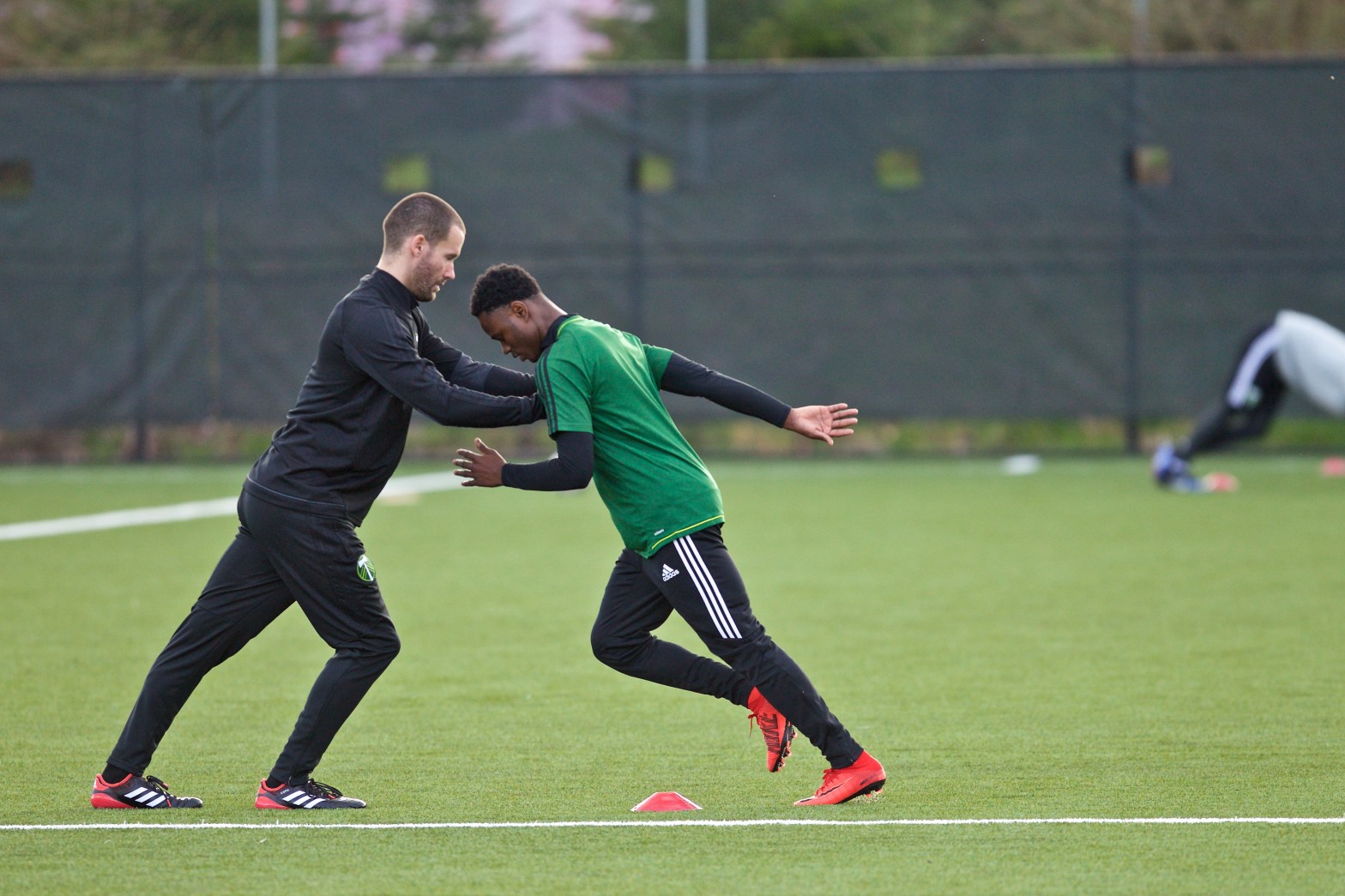
Accelerations/Decelerations: In order to get even close to what the group in the match is experiencing, you’ll have to integrate this during the warmup during in the second half. The acceleration piece is done often but I think high intensity decelerations are often overlooked. Getting the group cutting and absorbing force quickly and effectively during the warmup and during post-match fitness is huge.

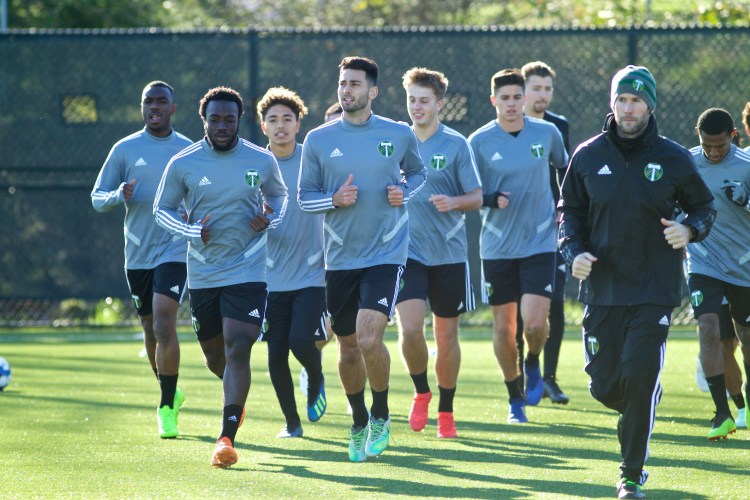
            With all that being said, let’s look at the timeline of typical match and how you can better maintain fitness for these bench players throughout the course of the game . In the 22nd minute of every match, I like to get the bench group up and moving around for a few minutes. It breaks up the first half – and if someone is suddenly subbed in at the 40th minute and they have to go into a 60m sprint right away, at least they weren’t literally sitting for 40-60 minutes prior to be getting thrown in (including time in the locker room, national anthem, etc.). Drills to open their hips, disassociated right from left, and adding a short burst here and there are my typical strategies for this three-five-minute segment.

            Once the second half begins, we begin warming up. It’s not rocket science. Dynamic movements and mobility blocks are mixed in. However, including longer runs where they build up in speed to higher thresholds across larger spaces become important as the warmup progresses. Also, incorporating sudden decelerations by stopping quickly at the end of movements should be incorporated consistently. By the time the second half is complete, everyone in that group should see accel/decel numbers that are roughly 50% of what the field players have experienced. They should have also accumulated between 150 to 200m of High Intensity Distance.

            Now, depending on positional groups and in-match averages we may have per person, we divvy up the number of box-to-box runs. It’ll likely range from 6-10 for field players with two of those being at faster speeds or their “sprint threshold.” Giving them a short, timed recovery between runs (roughly 15-20 seconds) ensures a bit of a heart rate response. For runs that are not in the sprint threshold, the athletes will decelerate quickly at the end of each run. Going from 70-75% of their max speed to a stop within 5-10m will continue to build those decelerations we started accumulating during the second half.

            Below I’ve included a screenshot of a report comparing two athletes. Athlete 1 is a young player who plays sparingly and is therefore on the bench most often. Athlete 2 is a starter who is still building his fitness but who is playing 90 minutes every week for our team. As discussed previously, total volume on match day will be challenging to achieve so Player Load and Acceleration Load for Athlete 1 are about 60% of what Athlete 2 attained in the match. He was also able to achieve 50-60% of the number of accels/decels, a higher volume of High Intensity Distance, and a higher volume of Sprint Distance. It is an over-preparation for this player but because he is young and his max speed is lower, we are utilizing the opportunity to build volume and work on tapping into those higher thresholds more often.

            It’s also important to note that on the graph marked “Cumulative Individual Loading (last 7 days),” we can see that in the area of Player Load and Accel Load, both athletes are remarkably similar. So even though the same volumes were not achieved on match day, small doses of extra work throughout the week, amount to equal loading over the grand-scheme of things. This does not always happen so nicely because of team considerations, schedules, training plans, etc. but when it does, it’s a big win.

            Now, the above strategy will obviously overload their system to a greater degree on match day in some metrics than those that played the match. If we can do so in a controlled environment though, and be consistent week to week, why wouldn’t we use this opportunity? Where we lack in total distance/total player load acutely, we try and make up for by being neurologically and muscularly more prepared. Will our weekly volumes be that of a starter in all metrics? Likely not all the time. But can we get damn close without throwing off training rhythms, schedules, and rest days? That’s the plan.

3 Thoughts on Tracking and Dosing High Speed Running

It’s a hot topic in the sports science world as everybody is constantly talking about High Speed Running or High Intensity Distance. It makes sense as higher velocity running has a significantly higher cost on the body as a whole and therefore should be closely monitored and tracked (if possible). But when it comes to the upper threshold of those speeds, how often should we dose it in and what are some components that should guide us on how much to give? Below are three thoughts I had on the matter:

85% is different than 90% and 90% is different than 95%

While we want to think of HSR as being anything over a certain percentage, we need to keep in mind the different effects these percentile jumps will have on our athletes physiologically. YLM Sports Science recently did a review of a study by Heiderscheit-Chumanove J Bomech (2007) showing that running at 100% of one’s maximum speed produced an eccentric load that is 50% higher than running at 80% of one’s max speed. Faster speeds provide exponentially higher loads and undoubtedly will take a greater toll on athletes physically. We shouldn’t see a 5% increase in speed as a 5% increase in load to the body. It just doesn’t add up that way although it would be nice if it did.

Figure 2: YLM Sports Science (2020)

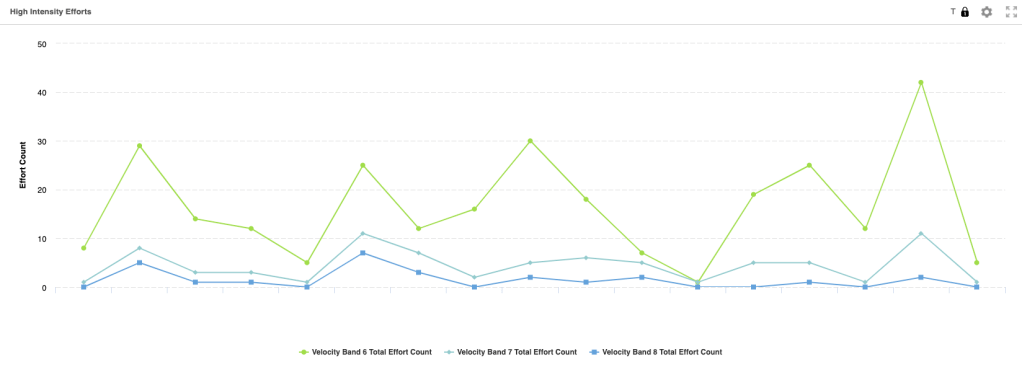
Don’t fall into the trap of lumping all high-speed running events into the same category. Know the difference between your bands and how often your athletes hit them. For me, athletes will often hit 60-75% of their max speed >40x in one match. Depending on their position, they will then hit 85-100% for roughly 1-5x in a match. Even if you don’t see a spike in total sprint efforts, it’s possible that they also went from hitting 4 efforts at 85-87% in 1 week to 3 efforts at >95% the next week. On paper it may seem the same but in reality, it’s very different. Below is a widget I’ve created that shows ways to longitudinally track the # of efforts at various speed thresholds. Depending on match or week averages, it allows me the ability to dose appropriately or attempt to limit an athlete when they’ve far exceeded or achieved less than their historical averages.

Figure 3: Example showing different volumes of efforts depending on the speed or “band” that is hit per instance. Track wisely and dose accordingly.

Control the controllables, dose it in

            I am sometimes dumbfounded as I look at my own historical data in that sometimes athletes will go for an entire month without hitting “sprint-speed” in a match. This is very position-specific but depending on a lot of factors, it can definitely happen. If you don’t dose in max effort sprints in training, they could go a very long time without hitting near their max speed. Consider comparing that to a powerlifter. If their squat is 450 but they never truly hit anything over 400, it’s unlikely they’ll be able to maintain their strength in those higher ranges for weeks or months on end.

            Dose sprints into training. Track live if possible and see if they get it in training. If not, get them building up into it. Some coaches worry about doing it at the end of training when fatigue has set in. Definitely something to take into consideration but in a match, they may have to do it in the 85th minute once they are incredibly fatigued. When I have any concerns with a player (high sprint count, high acute load of HSR, sore psoas, etc.) they’ll do their sprint on their own, building up gradually. If they feel good and we’ve built up our chronic load in-season, the group will race either in 2s or as a group. Max intent is important, and it never hurts to bring a little competition into training to bring out the best in athletes.

High-speed running density: 450m isn’t necessarily 450m

            In a study using an Irish rugby team, researchers looked at what they call “high-speed running density” (Tierney, Malone, Delahunt, 2018). Simply put, it is the number of high-speed efforts divided by the total HSR volume multiplied by 100. This directly relates to the first point I made but is a way to track it using a singular number i.e. by having your system report the HSR density. It is a different way to track and represent the data, but it is another layer to consider going forward.

Tierney, Malone, Delahunt, (2018)

            Two athletes may have the same volume of HSR exposure in a particular match. However, one athlete may have gotten their 450m over the course of 10 efforts whereas another one may have gotten it over the course of 35 efforts. Having a high percentage is going to mean that the athlete challenged their muscular and neurological systems again and again and again whereas the lower percentages mean that they had longer but sustained runs. How this affects your decision making is up to you, but I know that I am going to place an asterisk by those that have that higher percentage and constantly had to dig into their reserves to continue competing.

            Hopefully, these concepts spur a bit of thought on your own process. Interested to hear your thoughts and ideas as it pertains to maximal effort running. It is surely a topic I will continue to address going forward.

References

Chumanov, E.S., Heiderscheit, B.C., Thelen, D.G. (2007). The effect of speed and influence of individual muscles on hamstring mechanics during the swing phase of sprinting. Journal of Biomechanics, 40, 3555-3562.

YLM Sports (2020). Figure 1. Ylmsportsscience.com. Return to play & Injury prevention: running fast is much different than sprinting!

Tierney, P., Malone, S., & Delahunt, E. (2018). High-speed running density: a new concept.Science Performance and Science Reports, v1, 1-4.

Physical Considerations for Athletes Post-Covid

So your athletes went from being in crazy good shape to eating animal crackers on the couch and finishing “Friends” for the umpteenth time (obviously they were on a break). Okay so they probably didn’t take that much downtime, but when you compare what they’ve done compared to the complex demands of their sport, it is obviously very different. That being said, I had some thoughts on the main physical characteristics we need to work on re-developing once we get them back under our ever-caring wings of guidance:

Hip Extension

It’s a boring one but it’s true. Even if they went for a lot of runs, they likely spent way too much time in a deeply flexed position. Getting them to fully extend their hip for longer durations should be of high priority for just about every sport. My strategy is good ol’ glute bridges. Challenge different angles of knee flexion, get really good at iso’s at the top, and then progress to more dynamic movements. Once they can get back to holding iso’s for a decent duration (>30sec), let’s start increasing the velocity of their hip extension that is required in sport.

Decelerations

Depending on what sport you coach, your athletes see different volumes and intensities of decelerations. However, just about all sports have them to some degree. Lots of injuries occur during the deceleration phase as athletes try to absorb forces in a controlled manner again and again. Eccentric strength in the weight room is going to play a big role in this. For example, forward lunge variations, depth drops, and bungee/cable-assisted single-leg decel exercises will all help overload that mechanism. Also, simply monitoring the volumes of decelerations your athletes experience in the field of play will be incredibly important. Build into higher volumes over the course of weeks and months.

If you have GPS, great, you can monitor this to a more detailed degree. If you don’t have GPS, look at your “decel-heavy” drills and monitor how much time you spend doing those and increase the volume of those over time in a strategic manner.

Neuromuscular Control

To be able to hit high speeds or reactively get out of the way of a dangerous tackle, we need our neuromuscular system firing on all cylinders. A lot of athletes haven’t truly reacted to another person or hit a max sprint in months. It’s likely the longest they’ve ever gone without doing that. Let’s ease them back in. On the sprinting front, have them do a few weeks of build up sprints. Use waterfall starts so they can go at their own speed. Tell them various percentages to hit (80% -> 90% -> 95%). Give their bodies a chance to autoregulate themselves before getting them to race or attempt maximal velocity runs.

From a reaction standpoint, it might be harder to reintroduce things gradually as they will jump right into these during trainings. Choose your low hanging fruit then. Use your warmups to challenge their coordination via skipping or marching patterns. Get them reacting to your point, calling the colors of cones, or your movements. Make sure they are disassociating right from left during their fast feet drills, jabbing at different speeds depending on your call. The added benefit will likely be athlete engagement, fun, and an increase in mental agility as well.

As always, open to suggestions and would love to hear your thoughts. What are the physical qualities you’re most concerned with as we come out of this time?

Introduction and Salutations

Hello all. My name is Dan Jones. I’m a strength & conditioning coach, sports performance coach, sports scientist, rehabilitation specialist, trainer, part-time psychologist, and sport performance physical preparation something or another. Always hard to keep it straight, exactly what we all do when it comes to the field of strength & conditioning. Currently I work for the Portland Timbers organization and previous to that with the LA Galaxy, EXOS, and a private performance center called Twist Sport Conditioning. I have a BS in Human Physiology and a MS in Psychology.

The evolution and development of our industry has expanded our responsibilities but also complicated things quite a bit. And if I’m being quite frank, I don’t think there’s enough collaboration out there. There’s not enough discussion. There’s not as big of an exchange of ideas as I would like. We’re all to blame but in reality we’re all stretched thin. We’re busy coaching, managing relationships, continuing to develop our own methodology, and trying to have somewhat of a normal life away from work as well.

            I love what I do immensely. The craziness of the professional sports world is invigorating. We are constantly reacting to the situation: schedule changes, travel, coaches requests, last minute signees, etc. It’s engaging, it’s exciting, and it’s a lot of work. We also get to have pretty cool relationships with a lot of people. I’ve met incredible people at every stage of my career that I wouldn’t have had I chosen a different path. Outside of work, I love a good hike, I love to travel, and I love the show Friends (how dare you take it off Netflix). Currently I’m learning to play the guitar, getting back into reading fiction, and starting this blog.

I want to post about topics such as sports psychology, rehabilitation strategies, GPS monitoring, load tracking, utilization of sport technologies, how to manage athlete/coach relationships, how to attain buy-in from those around you, how to streamline your daily process as a coach, and to share what I’m currently learning or researching. It’s a lot I know.

My goal is to keep these posts quick & concise; like I said, we’re all busy. I want you to be able gain something out of it whether you are a strength coach, sports scientist, high school coach, or just interested in the field. Feel free to connect with me if you want to have further discussion on a topic. I look forward to meeting, discussing, and sharing ideas with you.