There are endless streams of data that us as performance coaches have access to, collect, and can analyze. And while I do not mean to add to that massive list of metrics, I do think there are some really interesting & simple metrics that get overlooked. Some of these are described below:
Consecutive days on feet: while not groundbreaking, this one simply translates to “how many days have they consistently been in without giving them a full day of recovery or full day off.” Sometimes we can get so caught up in the madness that is the season, congested schedules, and sticking to our periodization plan (MD-3 HAS to be in and small-sided). It’s also easy to lose track of academy or reserve athletes who are constantly moving between levels. Tracking this simple metric and throwing on some conditional formatting when it reaches >5 will help you spot these instances easily.
*Also monitoring “# of sessions in the last 30 days” can be interesting as it will give a rolling number that can get flagged easily and can inform when someone might be approaching chronic fatigue levels both physically and mentally.
Active time vs total time in training: Simply defined, active time is the time spent doing drills actively whereas total time includes the rest periods between sets and drills. Looking at these in comparison to one another (or as a percentage) can inform the coaching staff that with the session AS A WHOLE, there is too much unintended rest time because of explaining or coaching or possibly that more rest needs to be injected to sessions. While I personally have not tracked this over the course of a season, watching this as a trend over the course of the year would be incredibly fascinating.
Treatment counts: While staffs can generally give a subjective report that “x player always gets lower leg manual therapy,” seeing the objective COUNT of these metrics per player, position, age, and physical complaints also can provide some valuable insights into your team and athletes. Examining these trends over time as well provides insight into “are we putting a bandaid on the complaint or is the athlete progressing to a healthier overall state”.
There you have it. Simple but insightful metrics you can track with or without any fancy equipment. If you’re already collecting the data and just need to repurpose or automate how it’s displayed, even better.
Without quality systems in place in the team setting, the momentum from a couple wins can quickly dissipate into localized chaos. Most strength coaches are used to developing a lifting program for their athletes that consider the game schedule, offseason, and preseason. It seems like a no-brainer. But when we get into other realms of what it means to be a “performance coach” in today’s world, that sturdy systematic way of working oftentimes gets thrown to the wayside. The goal becomes to survive day to day and to keep athletes and coaches healthy and happy. However, by failing to develop systems in all other areas, we as coaches are leaving so much on the table, and here’s why they are so important:
Creates stability for athletes to rely on
Between playing time, relationships, and how they are currently playing, distractions are everywhere for athletes. Providing structure and creating a process for how WE work gives them something to stay grounded to. The way you define the process of how they come in in the morning, take care of their bodies, report fatigue, and participate in recovery all give their day structure that doesn’t change as the rest of things in their life does.
It encourages good habits from everyone
When you have a structured plan for an athlete’s return to play program, and you present that to the coaching staff and ask the question, “what does next week look like for training so I can adjust my plan?” you are immediately bringing up the standard for the entire staff. You are making the statement that “if I can plan my details out, so can you”. Plans will always change and we need to be adaptable, but don’t underestimate your ability to change team culture by always being the most prepared staff member in the room.
It allows us to continue our own development and REFINE our processes
If we don’t clearly define our initial process, how can we examine it for flaws or ways to be better? If we perform that return to play process differently for every injury, we’re never going to be able to definitively analyze that process and decipher how to improve that process. Altering that process every round will undoubtedly lead to pushing out some of the good with the bad, ultimately returning to net-zero improvement. Stick to your process, and after a significant amount of time, analyze the quality of it and the results, and make strategic changes accordingly.
Saves you energy by not having to make redundant decisions
We only have so much mental bandwidth. If we are choosing a new order to prepare for the day every day, we are depleting our mental energy stores before the day has even truly gotten underway. Spend time to develop a process, then simply stick to the script. Soon, things become mindless, and you can spend that mental energy on more important tasks WHILE performing your daily routine.
It creates objectivity
Our bias is everywhere. Whether we like it or not it is. By building a process for how you handle situations, it allows you to honor your experience (by initially developing a quality process) while avoiding making excuses for why things aren’t going a particular way.
Processes help us stay organized and on target. Examine the list below. Do all of these areas have clearly defined processes in place for you and your team? If not, consider starting that discussion.
When it comes to monitoring athlete health & well-being, it can feel like it rarely helps to even have a plan based off how often that plan must be upended. With a quality process for monitoring athlete fatigue and readiness though, this job becomes easier. In my current role, I meet with lots of teams that are trying to definitively say “this athlete is ready” or “we need to limit this athletes’ exposure”. The path to either statement is not always clear though.
Any one data point will not tell you how ready an athlete is. Multiple data points can get even more confusing; that is, without proper context. Below are a few ways to look at data to get a better reference for what the data is telling you:
Max Score (within a given time range)
This tells us what the athlete is capable of. When an athlete falls too far beyond their max (or minimum, depending on the variable) score, it’s good practice to ask more questions and dive deeper into why that might be. If testing is supposed to be “maximal,” fatigue, pain, soreness, psychological apprehension might all play a part in limiting what an athlete can currently do compared to what they are capable of when they are at 100% health.
Mean Score (within a given time range)
Depending on how often you take measurements, deviations from the mean scores can be quite telling. If you only test 2x per month on Nordics, and an athlete is now down 20% of their max force, it could feel normal to become alarmed. The mean tells us something different than the max though. The max tells us that at their VERY BEST, an athlete can perform in this way (whether that be in preseason, coming off a break, or the stars just aligned one day). The mean tells us that Athlete A typically performs like this. It pushes the abnormalities aside and focuses on what the athlete can do during a typical stretch of games/trainings. Whereas we might be alarmed to see a 20% decrease from their max score, if they typically test between -10% and -15% of their max, this is no longer alarming because of the added context.
Last Score
Lastly, comparing an athletes’ score on anything should always be compared to what they previously did. If there is a sharp increase or decrease, does this make sense given the amount of game-time vs training-time they’ve been exposed too? Oftentimes we can take an educated guess on why these scores deviate. It’s usually when we have a tough time explaining why the deviation occurred that we need to pay the most attention.
Below are some examples of various data types and the types of contexts you can add by looking at very simple calculations. This is not an exhaustive list but is meant as a general guide to how I personally look at various types of data in different date ranges. Keep in mind, this is how you frame someone’s CURRENT score and what to compare that CURRENT score to:
Loosely defined, fitness is one’s ability to complete work at a designated rate that is required to be successful in their sport. The primary energy system being utilized may differ depending on the sport and/or position, but overall, fitness really comes down to one’s capacity to do the work needed to compete at a high level.
When we look to periodize out work and manage “physical loading,” we also typically look for the minimum effective dose, aiming to give athletes enough to be successful but not too much to overload them. However, this begs the question, what are we defining as “successful”? My first thought tends to immediately jump to them performing on the field or court: if they were effective in the game, then they were successful. There are, however, other benefits to being fit than simply being able to fulfill one’s game-obligations. Some of these are outlined below:
We want a high capacity for games that must be won by physicality.
While most matches we want to win with a moderate physical output and maximum technical output, there are some games that need to be won by pure grit, who wants it more, and who has the CAPACITY to go hard in the final moments.
2. Relatively less internal load experienced=easier on the body.
At the end of a game, how big of a toll did it take on the athlete? The higher the fitness level, the less costly the game was for the athlete. While alcohol tolerance may not be the classiest of analogies, it is one of the better ones. Those with a high tolerance, can withstand a higher volume of ingestion and it somehow still does not affect them in a big way. The same can be said for physical loading. The fitter one is, the less of an effect game-like loads will have on them in terms of tearing them down.
3. Faster recovery post-match=less soreness
While very much related to the prior point, it stands to reckon that those that have a higher level of fitness, also recover more quickly. If a match load is A LOT for an individual and feels like a lot, it will likely take 2-3 days to fully feel like they’ve recovered. In my experience, fitter individuals that consistently are in the top 10% in terms of weekly production of distance or volume, typically are the ones who walk in the next day acting like they’re ready to train.
Being fitter isn’t the end all be all but it definitely helps in more ways than the traditional sense of merely being able to compete in the game. So when athletes demand to know why they must do additional work when they are “fine” in-game, explain to them that there’s a host of other benefits they will experience as they develop a higher level of fitness.
Reducing the number of injuries in any given season is one of the many ways that us as performance coaches leave our stamp on an organization. Injury reduction is likely one of the top priorities entering into every season and constant analysis and re-evaluation on how to best go about doing this should be a central part of how we spend our time. Some seasons, this preparation, attention to detail, and careful implementation will pay off dramatically and injury rates will drop dramatically from previous seasons.
Now if you’re like me, there is a grand sense of pride in doing this and when it comes time to talk about promotion or I’m talking to a colleague about successes from the season, it seems like a no-brainer that the reduced rates should be brought up. After all, in a world of complex variables where we spend much of our day performing tasks that seem to have an unmeasurable effect, it’s nice to be able to say that the squad was “13% healthier this year” because of what we did.
I would caution such a simplified statement though. Simple logic dictates that if I make the argument that my pay should increase by 10% because I (single handedly no doubt) reduced injuries by “x amount,” then what should occur during the following season when injuries increase by 13%? Any half-wit GM or colleague is going to either throw that right back in your face or simply lose some amount of respect for you and your process.
Simply put, it’s easy to take a lot of the credit when things are going well. And it’s also really easy to push any blame that arises to the “complex nature of sport and the many other variables that are out of our control” when things go poorly. The practitioners I respect the most though take the least amount of credit when things are going well and the most amount of blame when things go poorly.
It’s okay to be proud of the low injury rates and the success that your team of practitioners has had because of the hard work they have put in. Just make sure that you have substantial evidence of SEVERAL factors to justify that raise, promotion, or talk of success. Talk unmeasurables (quality relationships with players and/or coaches, improved development of young talent, increasing buy-in in healthy practices, etc.) as well as measurables (attendance during optional recovery sessions, re-injury rates, resolving chronic pains of specific players, compliance on wellness surveys).
Last thought: give praise to the players themselves for putting in the work and the rest of the staff that works so hard to maintain the health of athletes through grueling seasons. None of what you accomplish is possible without the athletes trusting you and the support that you receive from other practitioners. Pump up those around you and management will likely hear similar sentiments about your own contributions.
For performance coaches working in the soccer setting, it can be a constant conundrum we run into: when to sneak in high-quality lifting for our teams. There’s no simple way to go about it: coming off a Sunday match, we want to respect a 48-hour recovery-window but we also need to take into account:
Coaches plans for the week (likely desiring 1 or 2 days of hard training)
Off days (hopefully 1 per week)
The following weeks match and players desire to “not be sore”
In-season is a time when strength needs to be maintained so ideally the muscular system and the CNS both get stimulated at some point during the week. If we choose to lift heavy on the days that the team goes light, we simply will inhibit full recovery from high-intensity soccer sessions. Similarly, we will likely get large amounts of push-back from players as they have just started to feel better but now must complete a lift that they feel will lead to soreness for their upcoming match.
No matter what your weekly periodization model is, I would always aim for putting your heaviest “lower-body” lifting day on your hardest training day. This will concentrate the weekly load on the body but also allow for maximum recovery. When you spread out the gym and overload days on the field by a day or two, you interrupt the recovery process, turning a 48-hour recovery window into a 96-hour process where the athletes never feel well-rested or well-recovered. Most lower body lifting won’t exceed three sets of 4-6 reps and as long as the movements are not drastically different week to week, the volume should not produce mass amounts of muscle damage or CNS fatigue. Instead, these types of loads will allow athletes to build up into one or two heavy sets to maintain strength and keep their tolerance to produce and absorb forces high.
Now, the caveat is this: the weight room is supplemental to what they are paid to do. The focus should always be the field. So, if the field session was 120% higher volume than typical or an athlete comes in feeling completely depleted after a session, it’s also our responsibility to make adjustments on the fly. There will also be weeks where the above recommendation simply does not make sense. Multiple matches, a coach changing up the typical routine, or other unforeseen circumstances may make things more challenging.
The final component of instituting something like this is managing expectations. Athletes thrive off routine and knowing what to expect. Changing their routine messes with them mentally but can also have negative physical effects. Setting a precedent and letting them know the reasoning behind the periodization and allowing them freedom to even do some or all of the workout prior to training will drastically lower the push-back that one might receive.
When we think of movement screens, oftentimes our minds immediately go to FMS, YBT, force plate profiles, triple hops, and so on. Every team and/or coach has a unique combination that is useful to them and their process. These screens can provide so much information that allows us to track athletes’ progress, find baselines, and better evaluate their strengths and weakness which we can then target through exercise and treatment. A vital piece that is often missing from this process, however, is how the athlete functionally (arg I hate that word) moves on the field or court. That is, how do they naturally and instinctively move to accomplish the tasks that their position or role requires them to do?
I’ve had athletes score incredibly high on more “static” movement screens but then go out on the field and move absolutely miserably. Oftentimes, they are limited by their technical ability or the motor control necessary to accomplish the tasks at hand. On the flip side, there will always be athletes who have trouble with end range hip flexion in a standing Hurdle Step, but when they sprint, they get near perfect triple extension on the back leg and full hip flexion on the front leg. They tested poorly on our tests but functionally speaking, they are at the top of the food-chain.
There have also been instances where I’ve analyzed movement, found an area in need of improvement, trained it in isolation, and it did not transfer to the field one bit. For example, a fullback needed work on his drop step, opening up his hips to transition from a backpedal to a crossover run or sprint. First, we worked on mobility through the hips, allowing greater external rotation so that we knew he could at least physically have the capability. Then we worked on the motor control component, going through reps post-training, emphasizing a low posture, push with the front leg, and simultaneous rotation of the hips and trunk. Over time, it improved dramatically. However, once gameday came and we visually analyzed his movements, he was right back to his old habits.
Had we put him through a movement screen, he would have shown drastic improvement in several areas. Is it helping his performance though? Did it transfer to the field to make him a better player? Did it help our team win? No. So we went back to the drawing board, came up with some drills that included the ball, asked our assistant coaches to help design more realistic drills, and continued to work on it.
Understand that movement changes drastically when actions are done at higher velocities, when the environment is chaotic, and when they are in their element. Isolating and slowing movements down is great and tells us a lot of valuable information but there is more to it than that.
The point is, movement screens are great, but we must understand they are a piece to the bigger puzzle. As coaches, we must prioritize the health of the athlete but also look to improve their performance. There is so much to gain from analyzing on-field movement that it must become a habit. The more we consciously focus on analyzing movement when watching practices and games, the more natural it will be. And finally, and likely most importantly, it will allow us to speak the language of players and coaches in a way that tells them that we are prioritizing the game outcomes and the athletes’ development just as much as they are.
Developing how you report your data to the coaching/support staff/management can take a lot of time to develop and evolve. Framing your data in a way that is easily digestible, communicates value effectively, and is used to make informed decisions is incredibly important. Below I’ve listed out a few ways one can frame that data to provide context and understanding to a GPS or “team loading” report. While the examples given show GPS metrics, the same concepts can apply to team wellness, force plate measurements, or any other numerical data that is collected from a team.
Individual Day
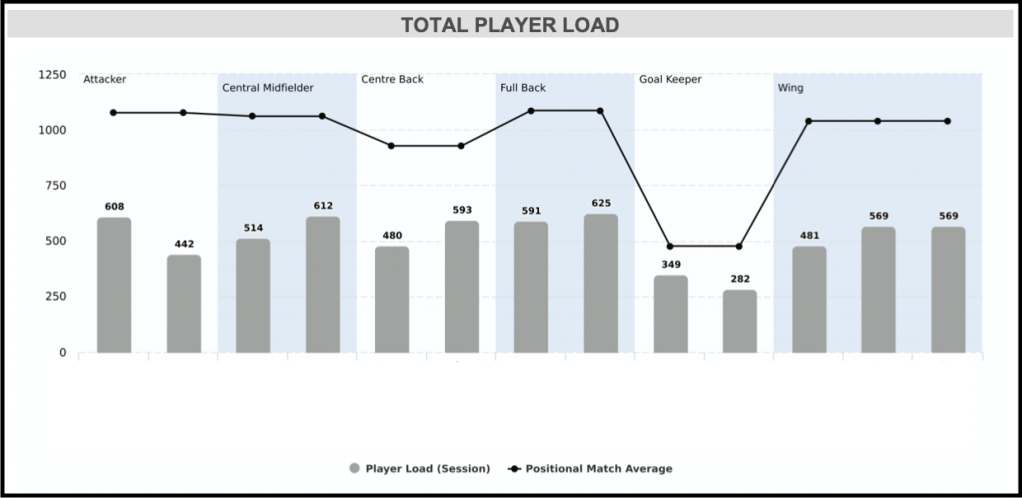
A stand-alone report that simply reports the values from the day is a simple option that conveys the daily values but with no true comparison to other relative moments in a training week. As seen above, this type of report is fairly simple to understand and see who the significant outliers are on the high-end and low-end. It communicates the information from the day and, depending on what system you are using, will likely adjust the axis so the focus is really comparing the athletes to one-another.
For simple comparison, I like to group my athletes by position so that you can immediately compare who is an outlier within their own positional group. Those playing the same position should have similar loads so if someone is high or low, it stands out a bit more when they are grouped by position. If the entire positional group is high, it was likely due to the unbalanced demand of the drills on that positional group.
Simple reporting is exactly that: simple. It communicates information but does not provide much context compared to any other trainings or matches. These types of reports can be great if you are explaining what metrics mean to a coaching staff or the basics of a report you will later build off of. It’s a good place to start but if we have the ability to provide more context, which will then provide more value, we should.
Relative to match average: team, positional, personal
A slightly more complex way to display information is to compare everything to the match average. Values will vary by team, so it is a way to objectively compare oneself to oneself. It provides a point of reference by which you can pivot around. Now, the question becomes, in your training week, do we want to hit 3x a match value on certain metrics? Should we sprint 1x of what we do in a match in one week? These are questions you have to answer for your own team, but the great thing is it will give you an anchor point to start from whether you are a team that relies on physicality or tactics to adjust training loads appropriately.
There are three ways you can look at an individuals’ metrics when comparing them to match values: team, positional, and personal.
Team: Take everyone who played >85% of the minutes, average out their metrics, and this is your new “Team Average”. You will have highs and lows but it gives you a solid place to start from when defining what the team should do on a daily basis.
Positional: Take the averages from each position of those who played >85% of the minutes and compare your daily data to that. This is my favorite because not all players will play much but because positional demands can vary so much, it still gives objective, relative targets for starters and non-starters to hit regularly.
Personal: Take what each individual average when they play >85% of the minutes and compare their daily data to those numbers.
This is highly specific but because not everyone will play often, it’s possible to have no data or only one or two data points on an individual. Also, considering the player-coach ratio of 22:1, individualizing to THAT degree will likely drive one to lose what little sanity is left. It is also unlikely for a coach to get each of the 22 players to hit their marks exactly every week. It’s important to think realistically so in order to maintain enough bandwidth to perform the job optimally.
Relative to that particular “Match Day –“
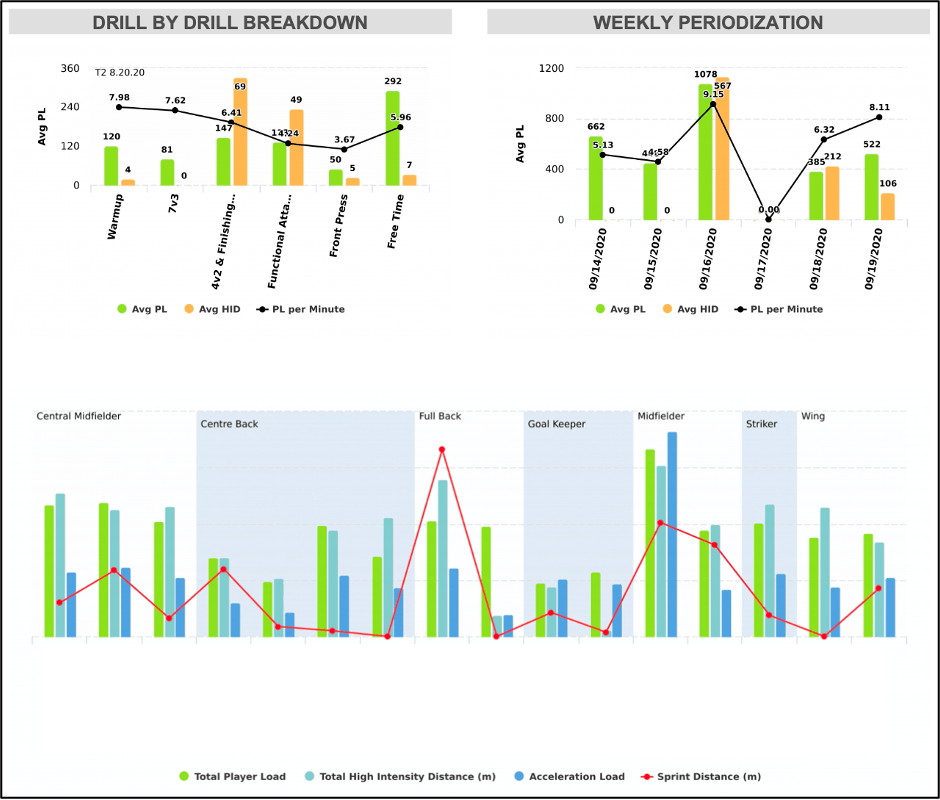
Another way to contextualize your daily data is to compare it to what athletes typically produce on that particular day during a training week. After about two months in season, we have a good volume of data points when it comes to our weekly schedule, periodization, etc. Our training weeks should start to stabilize as well if we were out of preseason. At this point, we can begin comparing individuals to what they or their positional group usually hit compared to that same “day” of a periodized week. For example, if Athlete A typically averages 350m of High Intensity Distance on Match Day -4, but during this week’s MD-4 he hit 123% of this, his particular bar graph will turn yellow or you can just visually see when it crosses over his particular “average line”.
This is great because you can immediately see post-training if anybody has spiked out of the ordinary in the acute phase. This may not tell us much about how their weekly accumulation looks or their global A:C ratios, but it gives us an immediate snapshot of what happened that day which can cause us to analyze deeper if we see something we don’t like.
This way of visualizing your data is also great for coaches who like to be consistent in their training and if they want their team to feel a sort of “rhythm”. It tells them when they are diverging far from the norm or if the team is hitting their overload or de-load days appropriately.
Similar to comparing your data to match averages, you can look at “Match Day -2” averages by team, position, or individual. They all have their respective advantages. Just make sure the added value is worth the added complexity.
However you arrange your data, make sure those reading it understand it. Make sure trends are recognized and understood and you reference them. When describing how you’ve planned the week out or what you would suggest, constantly refer back to the same context you use in your report to ensure its value sticks and the staff stays on the same page.
Whether you are beginning a new job, new season, or have access to new tech, it’s important to filter what information we deliver to others and how it is organized. Information needs to be delivered to the appropriate people and in easy-to-digest ways that actually contribute to decisions being made. As a young coach, I produced reports that had lots of information and were very detailed. However, how valuable or digestible was this information? Not nearly as much as I thought at the time. Below I outline a simple checklist you can go through to examine if what you are delivering to your coaches, management, etc. is appropriate or should be revised.
Does it keep the main thing the main thing?
With any report, make sure you can readily and simply explain why that information is important and pertinent to the athletes’ performance. I work in soccer. I need to make sure that whatever I am reporting on directly relates to their performance on the soccer field. Should I report to management and coaches that our top 3 prospects all have deadlift PRs that are >300 lbs? While strength is great, it’s not a simple task to explain to coaches why we’re going to win more games with that. However, showing them an increase in impulse on their jumps is very easy to digest and explain why it is going to help that athlete be more explosive.
Will it be used to make informed decisions?
At the beginning of every season, I have my athletes fill out a survey that tells me several seemingly random pieces of information about them. Are they coffee drinkers? What are the three meals that they are most proud of cooking? Are they early or late sleepers? It’s a collection of somewhat informal information that could help explain behavior that I will likely learn about by mid-season, so I just say hey, let’s find it out early. It can help us encourage positive habits and have targeted conversations over the course of the early months of the season. However, I don’t report this to the coaching staff because I don’t think any decisions should be made based off of this information, at least initially. It’s insight, but it’s not something that should make us treat anyone any differently in the acute phase.
Are outcomes/thresholds defined?
Wellness questionnaires are everywhere these days and tell us incredibly valuable information. However, what level of alarm do we give to certain numbers or number combinations? If a cumulative score is less than 24, it tells us that we may need to alter that person’s plan for the day. By having thresholds in place prior to running into an issue, it allows us to stay consistent and frees up our own mental capacity to not instinctively react to 500 different things in one morning. It allows us to be efficient with our time as a performance staff and relieves our process of ambiguity.
Figure 1: Make decisions easier by having a process in place to define various outcomes. It allows consistency and takes out the guesswork of last-minute decisions.
Is the information redundant? Does it tell a story we already know?
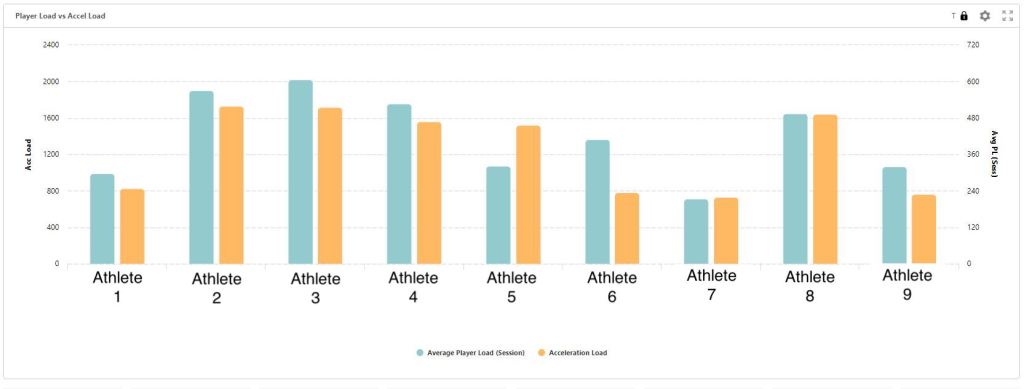
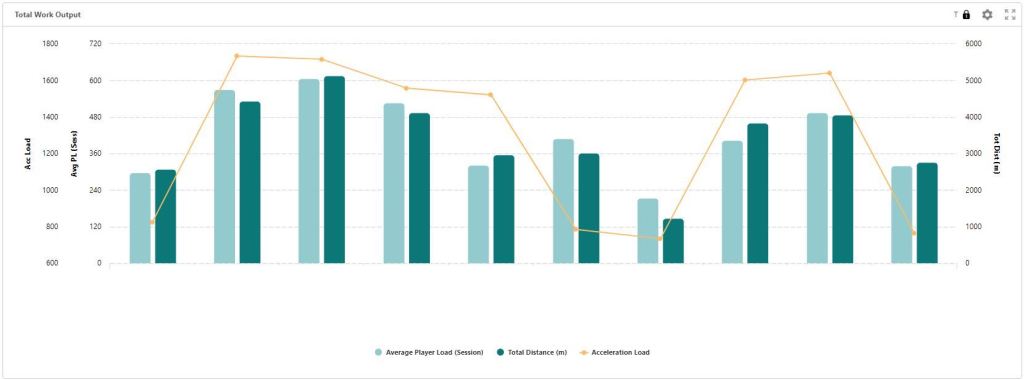
When I first started working with Catapult, I was wide-eyed with all the metrics at my disposal and wanted to show everything. What I realized over time though, is that some metrics almost always fall perfectly in line with one-another. Player Load and Acceleration Load are two of these metrics. 99% of the time, if someone is leading the group in PL, they are also leading the group in Accel Load (unless they did steady state conditioning during rehab). Does including both in a report give the coaching staff more to objectively use? Or does it muddle the report and decrease the attention given to all of the reported metrics.
Figure 2: If two metrics are almost always correlated, reporting on both will likely muddle the report. Choose one and then if you like, monitor both by yourself to find outliers. In this case, Athlete 5 is performing rehab which explains why his numbers were different.
Can you explain it simply? Do the decision-makers understand it?
I was helping a colleague redesign his GPS report once. It was a dazzling display of metrics and colors and thresholds. My colleague is incredibly smart and, as he explained his thought process, I sat there in awe. However, I also had trouble grasping a few of the concepts he was describing. Why did he put these three metrics on one graph? How should I interpret a particular combination of metrics that Player 1 is displaying compared to Player 2? After nearly 15 minutes I had a clearer understanding of the concept but only slightly. I asked more information about his coaching staff and learned that this is the first year they had ever seen a GPS report.
Bluntly stated, if a fellow performance coach has trouble absorbing and interpreting the data you are presenting them, it may not be appropriate to deliver to departments who have less of an understanding of those metrics. Should you track it on your own? Go for it! But once again, in most reports, we are after efficient communication and want to avoid muddling the waters with too many complex concepts.
Figure 3: Can I explain the complexities of the graph and it’s various outcomes/interpretations in less than a minute to someone who does not have a degree in physiology, kinesiology, or sports science? If not, maybe it shouldn’t be a part of your report to those people.
Is it ACTUALLY used to make decisions?
Great, your report passed all 5 criteria with flying colors. You’ve sent it to management and coaching staffs for several weeks/months. Now, what’s the effect of those reports? How many conversations has it stimulated? How many times has the report been cited by staff members? How many questions have you received about it? And finally, the big question, has it actually been used to make decisions? If it isn’t, it might be time to spend your valuable time elsewhere, instead of creating that report.
Look at the team as a whole. There are likely areas that could use a bit more of your time. There are likely lines of communication that could improve between you and the various people/groups you support. Focus your attention elsewhere and have an even greater effect.
Finally, if the report is not actually being utilized, have a meeting with those involved. Ask questions to find out what is confusing, redundant, or not valuable. Ask them openly for their opinion on the topic matter and see if you can tailor it a bit more to their likes/dislikes. People have biases and if you make a bit of effort to make the report even look more attractive to the individual you’re delivering it to, it’s likely they will look at it more closely and perceive it as more valuable.
Improve your reporting. Simplify it and you will likely see an uptick of support for it and it being used. Don’t put something together because you think it shows how smart you are. There is a lot of beauty in simplicity and communicating efficiently. Keep striving for it.
Injuries are tough. There’s no way around that. You never wish an injury to occur, but when they do, it’s important to view that time as an opportunity rather than a burden. Sure, you now have more programs to write and more one-on-one time to schedule into your day, but that time is incredibly valuable. Below I outline four of the primary ways I like to take advantage of the rehabilitation window with my athletes:
Relationship Building – This is likely an obvious one, but it’s the most valuable and needs to be done with intention. Learn more about their family, their background, and their hobbies outside of sport. Find out what they love or hate about the weight room and how you can do a better job of giving them more of what they like. Go beyond the surface and ask them why they do what they do, what motivates them to keep going.
Not only will you learn more about them and build rapport, but they will likely understand you better and build trust in you as a coach and mentor. Return their openness with your own and share your experiences with them. It will only deepen the relationship and allow you to have a greater effect on them long-term on and off the field long after they have returned from their injury.
Teach Quality Movement – Oftentimes, time is not on our side, so movement becomes our top priority. New signees occur right as pre-season begins, or we are already in the middle of the season and circumstances don’t allow us enough time to truly evaluate our athletes. Now, as “movement professionals” we are going to notice how they accelerate, decelerate, and change direction, but how much time can we give them to correct deficiencies when we have a massive number of athletes also relying on us?
Start with the basics, wall drills, marches, and skips. Teach them about quality posture and take the time to explain how it will make them a better athlete and affect their play. Take them through the progressions they may have missed and spend more time on the ones that they struggle with.
Fix Other Deficiencies – While we are all doing our best to write individualized programs from day one, we simply do not have the time or bandwidth to monitor and track every minor deficiency that our athletes carry. Soccer athletes, for example, oftentimes have poor shoulder mobility in the contralateral side of their kicking leg. Time spent rehabbing a hamstring, can also be used to help correct those deficiencies because once again, we have time and their undivided attention! It also creates a time where loading on the field or court is limited and therefore, they have more physical and mental energy to pour into their body.
Develop Positive Habits – While I know this is a crazy statement, athletes don’t always have the best habits when it comes to taking care of their bodies. Rehab is a great time to form a schedule with them. What they love most has been taken away from them to some degree and they are typically more motivated to do the required work to get back healthy. If you develop rapport and trust and utilize the time to educate them, athletes are more likely to “trust the process” and develop behavioral patterns that will help them regain their health and maintain it.
Teach them the value of preparing their body and keep them on a schedule that will stick with them once they are healthy. Emphasize preparation, prehab, recovery, and speak to them about the value of these things when they are healthy in order to prevent other injuries. Oftentimes they magically begin feeling better with the increased emphasis on self-care which should translate to long-term habits and them taking more ownership over injury-reduction.
I always say, “everyone wants to eat their vegetables once they are sick.” The same concept applies to athlete health: if they do the right things when they are healthy, they will have a longer, healthier career. Explain to them how to be proactive in their health and how they shouldn’t wait for injuries to derail the career that they’ve worked so hard to achieve.








 Peak Performance Platform